
What We Lose When Thinking Becomes Optional

There’s a saying about technology: “Like fire, technology is neutral. It can help us create amazing things or cause destruction.” You have probably heard it many times. If you work in the tech space, you’ve heard it so often that it begins to feel true, but is it? Neil Postman argues no in his 1985 book, Amusing Ourselves to Death.
Before diving in, you might ask, “What can a book from 1985 possibly teach us about today?” That was my first thought, but after reading it, I realized: “everything.” This is because we can analyze his warnings from a future perspective. Examining data over a long period reveals a clear view of our past. What we learn from the past also shapes the future we get to decide. I like to imagine that you and I are from Postman’s future, traveling back in time to discuss his book while reflecting on our current place in history and what lies ahead.
Technology isn’t neutral
Postman says that technology is never neutral because it inherently favors certain uses over others, thereby shaping our behavior and society. He gave the example of the printing press, which was invented for the mass distribution of written language. The invention empowered individuals by enabling them to acquire knowledge through self-directed reading and learning.
Television, as a technology, was invented for entertainment. As a result, we began to turn everything, from religious preaching to public debates and news, into entertainment. Covering a single topic in depth isn’t something a TV program can do effectively within its time limits. So we watch the news program, which can only provide a condensed account of a day's news around the globe, believing we are well-informed.
The problem isn’t that we enjoy entertainment from watching TV. It becomes problematic when we mistake entertainment for news, losing sight of what it truly means to be informed, Postman warns.
Performance over logic
On top of assuming we are well-informed when we are not, Postman pointed out another often overlooked reason why TV as entertainment can be harmful: it discourages critical thinking. Why do we almost never see people engaging in thoughtful reflection on TV? That’s because television is designed primarily for entertainment, not for authentic conversations. Thinking takes time, and it isn’t inherently entertaining, so it’s typically avoided, the author says. Key moments of reflection or real inquiry, like “What do you mean by that?" or “Let me think about that,” which are vital for meaningful conversations, are absent on TV. When we remove the thinking component from public discussions or debates, what we are left with is performance or theatrical acting, which rewards conviction over curiosity.
What’s more, television’s focus on performance rather than logical argument creates problems in important debates, such as U.S. presidential debates. In such performance-focused TV debates, speaking skills matter more for persuading viewers than a candidate’s policies. As a result, candidates who effectively project confidence can attract some viewers, even if their arguments lack facts or logic. Critics argue this dynamic helps explain why a former reality TV star like Donald Trump was elected president, as people confused his TV persona with the real person.
Illusion of knowing
How does this connect to the world today? Postman couldn’t have predicted social media, streaming services, and AI, but his thinking framework still holds. From my reading of the book, we should ask three questions when evaluating any technology: What is its purpose? Does it enhance our critical thinking? And what hidden harms might it cause?
“TV offers a variety of subject matters, requires minimal skills to comprehend, and is aimed at emotional gratification.” —Neil Postman, Amusing Ourselves to Death
Let us first look at what social media is for. Social media is designed to connect us. That was how it was sold to us in the beginning. While some small part of it may still be true, its goal has long shifted to keeping users engaged on its platform for as long as possible because it generates revenue through ads. Like TV shows, we religiously check social media for news about the latest natural or man-made disasters, conflicts, the latest who-said-what, and tell ourselves we are simply staying informed.
Does social media help us think? Perhaps. One can argue that short-form content is easy to absorb and is better suited to today’s world. At the same time, “doomscrolling” has become a word. Our feeds are personalized to keep us hooked, which means the content we see on social media varies. In a way, the algorithm functions as a magnifying glass for our own views of the world, choosing posts that reflect our thoughts and reinforcing our reality by strengthening our beliefs. Without critical thinking, we can easily form different realities based on what we “see,” which fuels a political divide that feels impossible to bridge.
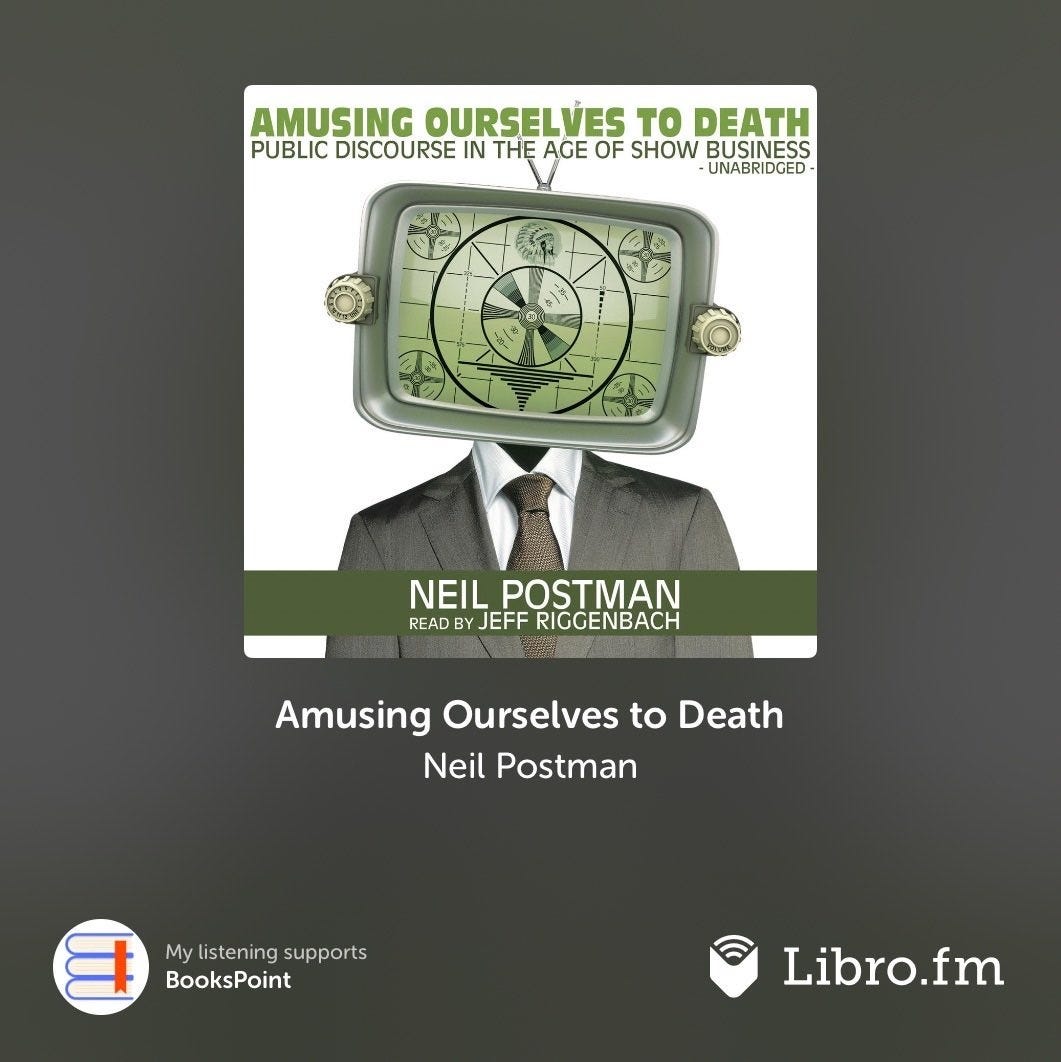
Postman's definition of disinformation feels especially relevant now:
“Disinformation doesn’t mean false information; it means misleading information. Misplaced, irrelevant, fragmented, or superficial information. Information that creates the illusion of knowing something, which in fact leads one away from knowing.” —Neil Postman, Amusing Ourselves to Death
When thinking becomes optional
Consider streaming services like Netflix and YouTube. Like traditional TV, they offer many entertainment options, but they tend to be more distracting, making it rare for viewers to pause and think critically. Netflix, in particular, offers many mediocre stories that can occupy you for days, with only a few genuinely memorable. I admit I’m no different. I fall into this trap too. Their platform is intentionally designed for binge-watching, encouraging you to stay glued to your screen instead of giving you a chance to step away and get some sunlight. They prefer you remain seated in front of your TV or device, no matter where you are.
Rather than the iconic phrase, “Big Brother is watching you,” from Orwell’s 1984, Postman argues we’ve become so captivated by entertainment that instead of having a monitoring TV machine watching our every move at home, we can’t take our eyes off it. In Postman’s view, the world aligns more closely with Aldous Huxley’s Brave New World, where we numb ourselves with amusement at the expense of critical thinking.
We've discussed how TV discourages critical thinking, how social media fosters societal divisions, and how the endless entertainment choices on Netflix and YouTube take away our time from experiencing the real world. What might occur when thinking becomes optional due to the rise of AI?
What about AI?
Today, we find ourselves at a pivotal moment in history, marked by the emergence of AI. Postman showed us that even something as seemingly harmless as TV has significantly influenced our society. At present, we have only begun to see the impact of early technology use on our children’s cognitive development, as highlighted in Jonathan Haidt's book The Anxious Generation. It’s natural to question and assess how AI will affect our critical thinking skills.
While AI offers incredible benefits, such as early detection of health issues and clearer writing, we must remember it’s designed to automate specific tasks, which can make our lives easier but may also have drawbacks that aren't immediately obvious. Relying too heavily on AI might reduce our confidence in our own thinking and actions. What was once just a humorous idea in Mike Judge's 2006 film Idiocracy now feels like it could be happening for real.
Technology has influenced our development over time, and many of us, myself included, have accepted what technology offers without critically evaluating whether it’s beneficial or harmful. There are compelling reasons to support technology, such as greater convenience, improved connectivity, and tools that boost work productivity. However, we also tend to prioritize performance over logic, the illusion of knowledge over genuine conversation and understanding, and endless entertainment and convenience over critical thinking.
When thinking becomes optional, facts become debatable, and truth becomes a choice. Recent years in the U.S. have made this painfully visible — where settled climate science becomes opinion, and documented injustice becomes revisable history. We watch as ICE targets Hispanic and Black immigrant communities. While many protest and fight back, those in power pretend this isn't a path we've walked before.
So what can we do? Education, as Postman suggested, is key.
Before reaching our own conclusions, education teaches us to learn from history, question our assumptions, and search for evidence, all key components of critical thinking. Education can help us regain our ability to think deeply, ensuring we don’t drift into a Brave New World-like future, immersed in a sea of amusement and entertainment, where we’re glued to our devices rather than engaging in activities that challenge our minds.
Alongside formal education and self-learning, I believe reading plays a vital role in lifelong learning. If you find it hard to read or finish a book, start with poems, articles, or shorter stories. Listening to audiobooks also helps. We must train our attention span so we can think clearly again.
“Civilization is in a race between education and catastrophe. Let us learn the truth and spread it as far and wide as our circumstances allow. For the truth is the greatest weapon we have.” —H. G. Wells
Postman’s book offers a treasure trove of wisdom, especially about television’s impact on a society’s ability to absorb in-depth information. Amusing Ourselves to Death remains relevant today not only as a warning about our past choices but also as a cautionary tale about a future we should avoid.
I’d love to hear from you. Have you noticed your own thinking changing in this age of endless entertainment? And if you’ve read Amusing Ourselves to Death, what stuck with you and why?
Note: This article contains affiliate links for Libro.fm. If you make a purchase or become a member, I earn a small commission at no additional cost to you.